When to replace the cylinder
- you've lost a key, or someone you no longer trust has one
- you've moved in and don't know how many keys are out there
- the key sticks or turns stiffly even after lubricating
- the cylinder is old, cheap, or sticks out of the door hardware
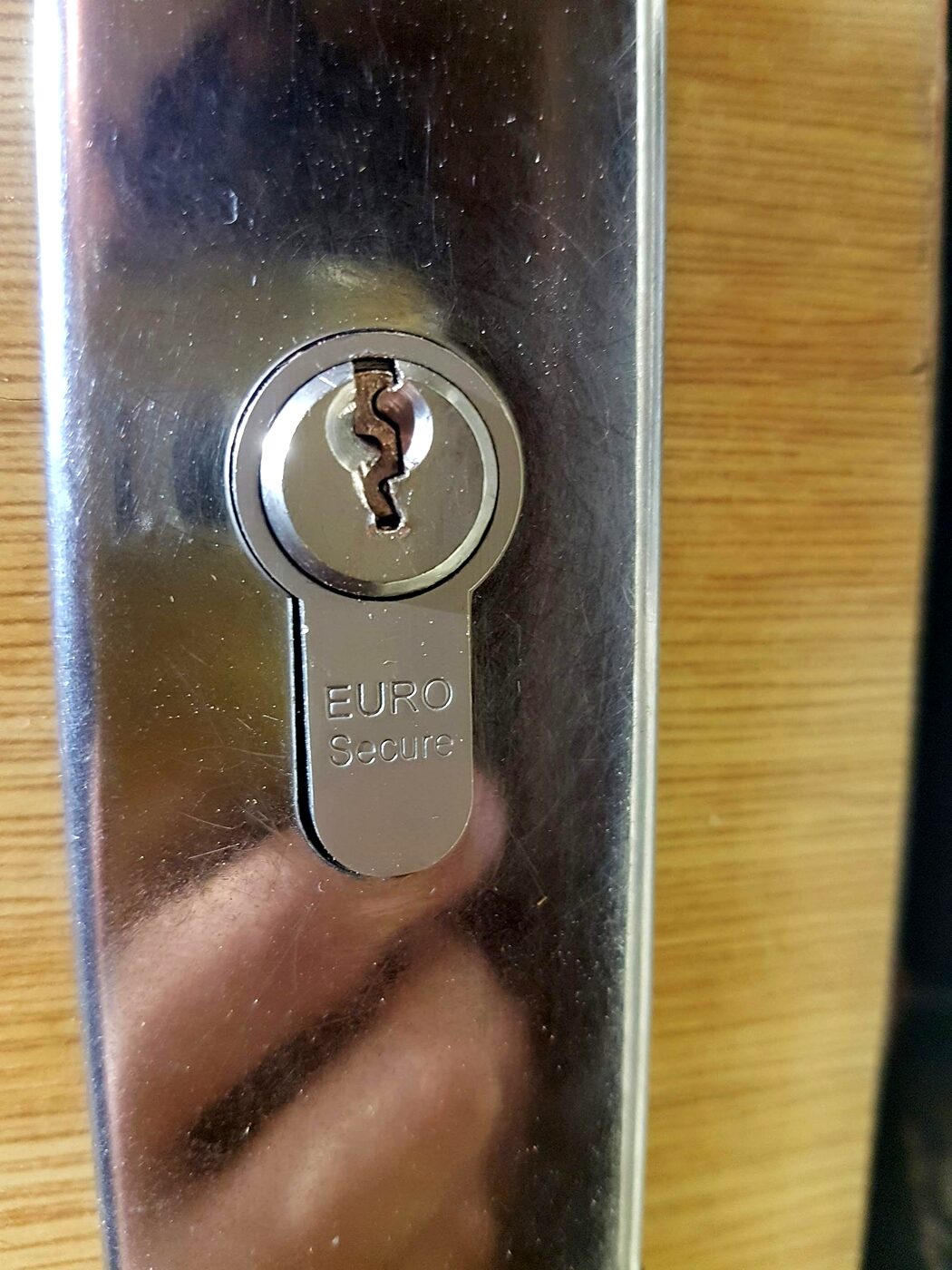
Key sticking? Don't ignore it.
A key or lock that sticks is a warning. A jammed lock or a key broken off inside is harder and more expensive to deal with — and it happens at the worst moment: in the evening, in winter, when you're in a hurry. Prevention is cheap: lubricate the lock or cylinder in time, or replace a worn cylinder or lock. (On every job I lubricate your lock with a quality lubricant for free.)
1 Take out the old cylinder
- Open the door and keep it open the whole time. If something gets stuck, you won't be locked out.
- On the lock faceplate (the metal strip on the edge of the door), find the long screw at the same height as the cylinder and unscrew it completely.
- Insert the key and turn it slightly one way or the other until the cam (the little lever in the middle of the cylinder) lines up with the cylinder body — pull or push on the key while you do it. Then pull the cylinder out by the key.
Won't come out? Try turning the key a little further, or the other way. Don't force it.
2 Measure it
A cylinder is measured from the centre of the screw hole to each end separately. You get two numbers, e.g. 30/35 mm. Cylinders come in 5 mm steps (30, 35, 40, 45…).
Measure from the centre of the screw hole, not from the cam.
Did the old cylinder stick out, or sit too deep? Measure the door instead.
Measure from the screw on the faceplate to the outer surface of the door hardware — on each side separately. On the outside, choose the size that ends flush with the hardware, or at most 3 mm beyond it: a protruding cylinder can be snapped off with pliers and the door opened without a key. On the inside it can stick out more.
The door seen from above. The cylinder size is the distance from the screw to the outer surface of the hardware on each side.
3 Which cylinder to buy
Don't save money on the cylinder — it's the heart of your door's security. Choose a security cylinder of at least security class 3 (it holds out a little longer against drilling, picking and so-called bumping), not the cheapest one on the shelf.
Security is only as good as the whole door
A security cylinder alone isn't enough. A door is only as strong as its weakest part: the cylinder, the door hardware, the lock (the mortise lock inside the door that the cylinder slides into), the door itself and the door frame. An expensive cylinder in ordinary hardware can be snapped off, and a weak door or frame can be forced even with the best lock. I'm happy to tell you where your weak spot is.
- Choose security door hardware, at least in the same security class as the cylinder. It holds the cylinder from the outside, so there's nothing to grab with pliers. Hardware with a cylinder guard also protects it against other kinds of attack. If you can see screws on the outside, it isn't security hardware.
- Snap protection: if it isn't listed for the cylinder, it simply doesn't have it.
- Good cylinders on the Czech market come from Tokoz, GeGe and EVVA. You can also order cylinders online using your measurements (Tokoz or Kovotechnika will even make non-standard sizes).
Emergency clutch or thumb turn?
Decide how the cylinder should work from the inside:
Cylinder with an emergency clutch
You can unlock from outside even with a key left in the lock on the inside. With an ordinary cylinder, a key left inside blocks the lock — the classic “we can't get in, grandma left her key in on the inside”.
Thumb turn (knob)
Instead of a key there's a knob on the inside — you lock up without looking for your key. Good for apartments. Not for doors with glass (break the glass, turn the knob), or where the knob can be reached from outside, e.g. double doors with a gap between the leaves.
One key for every door
Several locks — front door, cellar, garage? Cylinders can be ordered keyed alike, so one key opens all of them. Kovotechnika, for example, makes them to order, and you can order them online too. Ask for it when you buy all the cylinders together — adding one later is harder.
4 Fit the new cylinder
- Insert the key into the new cylinder, turn it slightly just as when removing the old one, and slide the cylinder in — the right way round.
- Screw the screw back in. If it won't go in, the cylinder isn't quite lined up — wiggle the key until the screw finds the hole. Don't overtighten it.
- With the door still open, lock and unlock from both sides, all the way. Only then close the door and try again.
If the screw won't budge or is rusted, or the cylinder won't come out even with the key turned — don't force it. Get in touch.
Not sure? Send a photo or call.
I'll advise you over the phone — from a photo of the lock, often for free. And if needed, I'll replace the cylinder for you.